On Wednesday, February 13th 2013, our group
interviewed Dr. Laura Salem (see picture below) in her office in the biology department of
Rockhurst University. We selected Dr. Salem as our expert because she is a
geneticist and because the main focus of our grid-computing program, dna@home,
is discerning the regulation of genes through transcription factors. As all of
us had been in Dr. Salem’s genetics class last semester, there was not really
much need for an introduction, however, we did ask for permission to set up an
interview via email beforehand. After getting the ok from Dr. Salem, we made
arrangements for our interview in person.

The
questions that we had prepared for the interview revolved around several
topics. We began by catching up with Dr. Salem a little bit, asking her how her
holidays were, and inquiring about the signed Gary Larson cartoon she has
framed in her office. Apparently, her father was once an editor for Mr. Larson.
We also inquired about Dr. Salem’s education and why she became a geneticist.
Dr. Salem attended Rockhurst University for her undergraduate studies before
receiving her Ph. D. from Iowa University in 2000. She then did three years of
post-doctorate research at UMKC studying meiotic recombination and transposable
elements in yeast. For the past nine years she has been teaching at Rockhurst
University. She rotates through teaching the cell biology, genetics, bio tech,
general biology 1, and introduction to research courses. We then asked Dr.
Salem if she was familiar with the concept of grid-computing. She responded by
saying that while she is familiar with the concept, she has not participated in
grid-computing herself. She mentioned some interest in the application of
grid-computing and thought that genetics was a particularly apt field to which
it could be applied.
From
here, our questions turned more pointedly to the nature of gene regulation. We
began by simply asking how cells regulate what genes they express and how often
they express them. Dr. Salem professed that she was not an expert on gene regulation;
however we found that hard to believe as this simple question unlocked a wealth
of information possessed by Dr. Salem. She walked us through a brief overview
of the transcription process by which a cell fabricates mRNA. During this
process, an enzyme called polymerase attaches to a gene which is composed of a
sequence of nucleotides on the DNA. The polymerase then travels down the DNA
strand and transcribes the genetic code into a complementary strand of mRNA
which is then transported out of the cell that it may be used to make proteins.
Small proteins called transcription factors help the larger polymerase locate
and attach to the correct gene so that it may then start making mRNA. A
particular kind of transcription factor, called an enhancer, is especially
important in up-regulating the expression of genes. Conversely, some
transcription factors known as insulators may attach to the DNA strand and serve to help keep a
gene “turned off” by blocking the polymerase from attaching. See below for a diagram displaying transcription factors.

This description of transcription
and the ways in which transcription factors affect it spurred us to ask this
follow up question: Are there any other ways in which scientists can help
manipulate a cell so that certain genes are expressed more? Dr. Salem then went
on to describe how we can sometimes aid a cell in expression a gene more often
through histone interactions. We asked what histones were and she told us that
they are proteins that aid in the ordering and packaging of DNA molecules. They
essentially act as spindles around which DNA molecules are wound into
structures called nucleosomes. Dr. Salem elaborated by saying that a DNA
molecule must be unwound from around its histone before transcription ban take
place. This is because the two strands of DNA must be broken apart from each
other so that polymerase can read the nucleotide sequence and fabricate mRNA. Because
there is not enough room in between the two strands of DNA for polymerase to
fit, the DNA must be uncoiled. Some scientists are taking advantage of this
knowledge by forcing DNA to remain uncoiled for longer periods of time. This
allows the cell to make more copies of mRNA from the gene which may in turn be
used to make more proteins. A diagram of histones can be found below.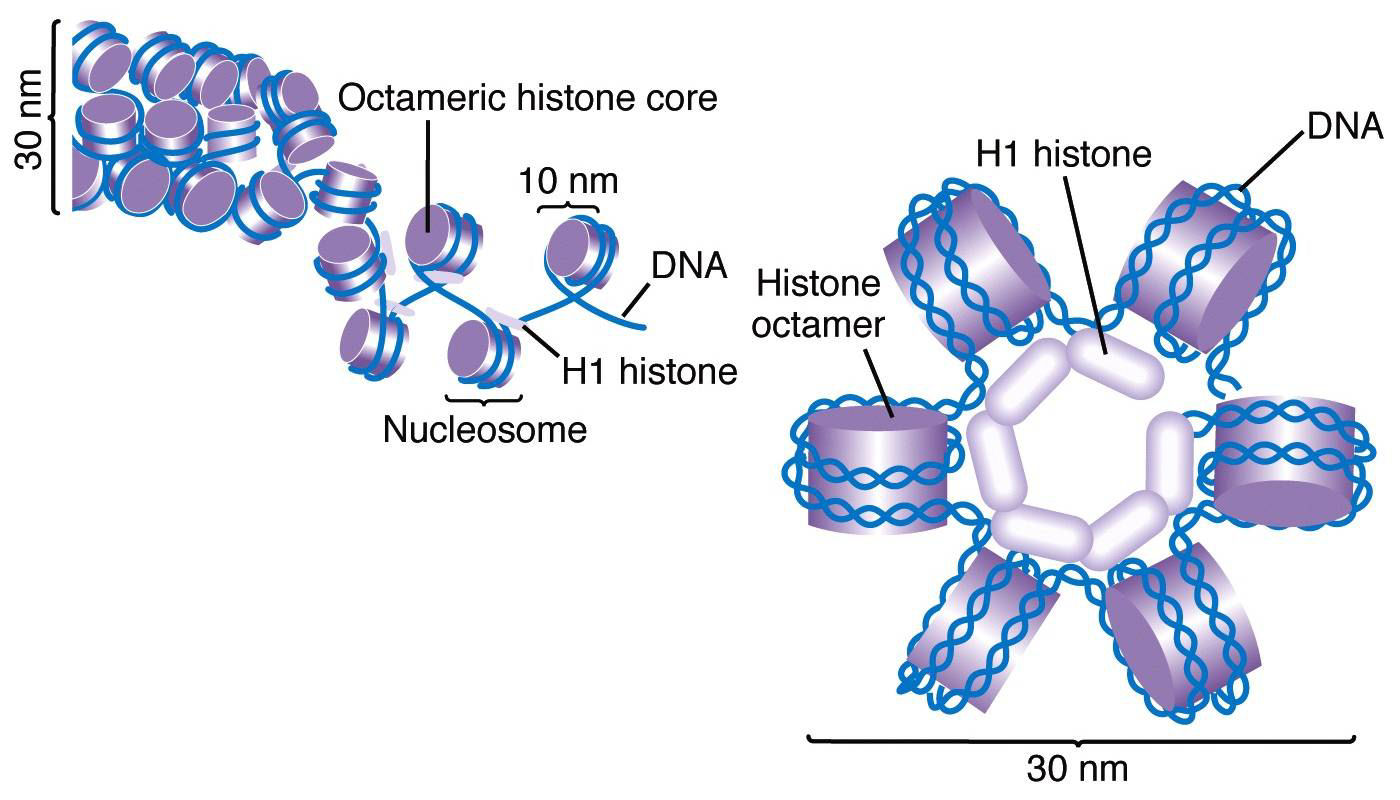
To wrap the interview up, we asked
Dr. Salem if there was anything else that we had missed that we should know.
She noted that we should distinguish between two types of genes. There are
genes within a cell that code for proteins that are so necessary for normal
function that they are, in a sense, always turned on. Other genes, however,
code for proteins that may have a much more dramatic affect within a cell. Dr.
Salem surmised that gene regulation therapy, if applied to medical science,
will most likely focus on these genes rather than the basal “always on” type
genes. Furthermore, as a piece of advice for our group as we continue to study
the nature of gene regulation, Dr. Salem warned us that the field of genetics
is a very vast one. Many scientists devote their entire lives to studying very
specific aspects of genetics and gene regulation. She therefore suggested that
we narrow the scope of any future research that we may conduct for fear of
being overwhelmed. We then thanked Dr. Salem for her time and told her how much
we enjoyed talking with her. She wished us the best of luck on our blog and said
she would look into grid-computing a little more. The interview lasted
approximately thirty-five minutes as Dr. Salem had a department meeting she
needed to attend.
As a result of this interview, we
learned much about the regulation of genes due to the manipulation of histones
and transcription factors. This was especially pertinent information to
dna@home as it is devoting processing power to search for the nucleotide
sequences that transcription factors bind to in the genomes of Yersinia pestis and Mycobacterium tuberculosis. As a group, we now possess a better
understanding of both the importance of finding these elusive nucleotide
sequences and what can be done with them once they are found.

Hi,
ReplyDeleteNice job! She really is an expert, whether self-professed or not! Now if you can just add a few statements about how this all relates to evolution, and change "myotic" to "meiotic," you'll be set.
Thanks!
Dr. Walker