Thursday, April 18, 2013

Our professor, Dr. Mindy Walker, posed some questions for us to answer in regard to the scientific study posted below. What fallows is the questions themselves as well as our answers to them.


Questions – Gene Regulation


Questions 1-4 are based on the PNAS article entitled “Regulation of gene expression in the mammalian eye and its relevance to eye disease” by Scheetz et al. (2006).


1.      This is a multi-part question.  To answer it, you will need to go to www.ncbi.nlm.nih.gov and follow these instructions.

From the drop-down search menu, choose “Nucleotide.” Type abca4 in the box to the right and hit “Search”.

Click on the Xenopus abca4 gene (second entry). On the right side of the page, click “Run BLAST.” On the next page, click the BLAST button at the bottom (and wait…).


  1. Scroll down your results page.  What other taxa (scientific and common names) share some sequence identity with this Xenopus gene?

Gallus gallus (Red Junglefowl),

bos taurus (domestic cow),

sarcophilus harrisii (tasmanian devil),

trichechus manatus (West Indian Manatee)


  1. What is Xenopus?


Xenopus is a genus of highly aquatic frogs native to Sub-Saharan Africa.


In an evolutionary sense, why study gene regulation in this animal? 


It makes sense to study these animals because of their close evolutionary relationship with humans when compared to other model organisms. Also, they are only vertebrate model system that allows for in vivo analyses of gene function as well as biochemistry.


Why study it in rats, as they do in your paper?


The authors of our paper cite six criteria that they looked for in choosing a species for their experiment. They are: 1) to be highly inbred 2) to be commercially available it otherwise readily available from academic institutions 3) to have widely diverse genetic origins 4) to have genotypic data available so that genetic diversity between strains and the degree of inbreeding within strains could be assessed and so that informative markers could be selected for the mapping cross 5) to be robust breeders, and 6) to be free of early-onset systematic phenotypes or degenerative eye phenotypes. Presumably, the rat strains that the authors selected met all of these criteria. Furthermore, rats make a good candidate for studies in gene regulation because they are cheap and their cellular processes of gene transcription and translation are analogous enough to those of humans.


  1. What does wild type abca4 do in these animals?  Why is it conserved across so many disparate species?


Wild type abca4 codes for a retina-specific membrane-bound protein that acts as a flipase enzyme that is only found in multicellular eukaryotes. This enzyme transports ATR and NR-PE from the extracellular membrane surface to the intracellular membrane surface in retina photoreceptor cells. Mutations in this gene cause early-onset macular degeneration (genecards.org).


Abca4 is conserved across many different species due to the early development of this gene and the eye in eukaryotes (nih.gov).  


2.      What does the mutated abca4 allele cause in humans?

The mutated abca4 allele causes the autosomal-recessive disease called Stargardt macular dystrophy (STGD). Stargardt disease is one of the more common forms of heritable blindness among children and young adults.


3.      How does correlated expression of genes like the BBS genes in this study indicate gene regulation?

If genes share a strong correlation in that they are often mutually expressed at the same time, then it follows that they are co-regulated as well. The mechanisms in place that causes one gene to be regulated (expressed more or less) may be the same mechanism in place that regulates another gene. These co-regulated genes would then appear as correlated genes as well.


4.      What are microarrays?  What do they have to do with the goal of DNA@home?

DNA Microarrays are small, solid supports onto which the sequences from thousands of different genes are immobilized, or attached, at fixed locations. A microarray works by exploiting the ability of a given mRNA molecule to bind specifically to the DNA template from which it originated. By using an array containing many DNA samples, scientists can determine, in a single experiment, the expression levels of hundreds or thousands of genes within a cell by measuring the amount of mRNA bound to each site on the array.


The ultimate goal of DNA@Home is to discover what regulates the genes in DNA. Thus the discovery of microarrays makes it possible to perform a number of experiments that examine the expression of thousands of genes in a large number of related individuals and to use this data to identify the chromosomal locations of the genetic elements that are responsible for the variation in gene expression among individuals. This technology will also aid the examination of the integration of gene expression and function at the cellular level, revealing how multiple gene products work together to produce physical and chemical responses to both static and changing cellular needs.


Sources:

The research paper


The message you tried to print is protected with Information Rights Management. The sender didn't give you the rights necessary to print the message.


Tuesday, April 2, 2013

Here is the link to a scientific journal on the regulation of gene expression in the mammalian eye and its relevance to eye disease:
http://www.jstor.org/stable/pdfplus/30050391.pdf?acceptTC=true

Friday, February 15, 2013

Interview with Dr. Salem


               On Wednesday, February 13th 2013, our group interviewed Dr. Laura Salem (see picture below) in her office in the biology department of Rockhurst University. We selected Dr. Salem as our expert because she is a geneticist and because the main focus of our grid-computing program, dna@home, is discerning the regulation of genes through transcription factors. As all of us had been in Dr. Salem’s genetics class last semester, there was not really much need for an introduction, however, we did ask for permission to set up an interview via email beforehand. After getting the ok from Dr. Salem, we made arrangements for our interview in person.
Photo

                The questions that we had prepared for the interview revolved around several topics. We began by catching up with Dr. Salem a little bit, asking her how her holidays were, and inquiring about the signed Gary Larson cartoon she has framed in her office. Apparently, her father was once an editor for Mr. Larson. We also inquired about Dr. Salem’s education and why she became a geneticist. Dr. Salem attended Rockhurst University for her undergraduate studies before receiving her Ph. D. from Iowa University in 2000. She then did three years of post-doctorate research at UMKC studying meiotic recombination and transposable elements in yeast. For the past nine years she has been teaching at Rockhurst University. She rotates through teaching the cell biology, genetics, bio tech, general biology 1, and introduction to research courses. We then asked Dr. Salem if she was familiar with the concept of grid-computing. She responded by saying that while she is familiar with the concept, she has not participated in grid-computing herself. She mentioned some interest in the application of grid-computing and thought that genetics was a particularly apt field to which it could be applied.

                From here, our questions turned more pointedly to the nature of gene regulation. We began by simply asking how cells regulate what genes they express and how often they express them. Dr. Salem professed that she was not an expert on gene regulation; however we found that hard to believe as this simple question unlocked a wealth of information possessed by Dr. Salem. She walked us through a brief overview of the transcription process by which a cell fabricates mRNA. During this process, an enzyme called polymerase attaches to a gene which is composed of a sequence of nucleotides on the DNA. The polymerase then travels down the DNA strand and transcribes the genetic code into a complementary strand of mRNA which is then transported out of the cell that it may be used to make proteins. Small proteins called transcription factors help the larger polymerase locate and attach to the correct gene so that it may then start making mRNA. A particular kind of transcription factor, called an enhancer, is especially important in up-regulating the expression of genes. Conversely, some transcription factors known as insulators may attach to the DNA strand and serve to help keep a gene “turned off” by blocking the polymerase from attaching. See below for a diagram displaying transcription factors.

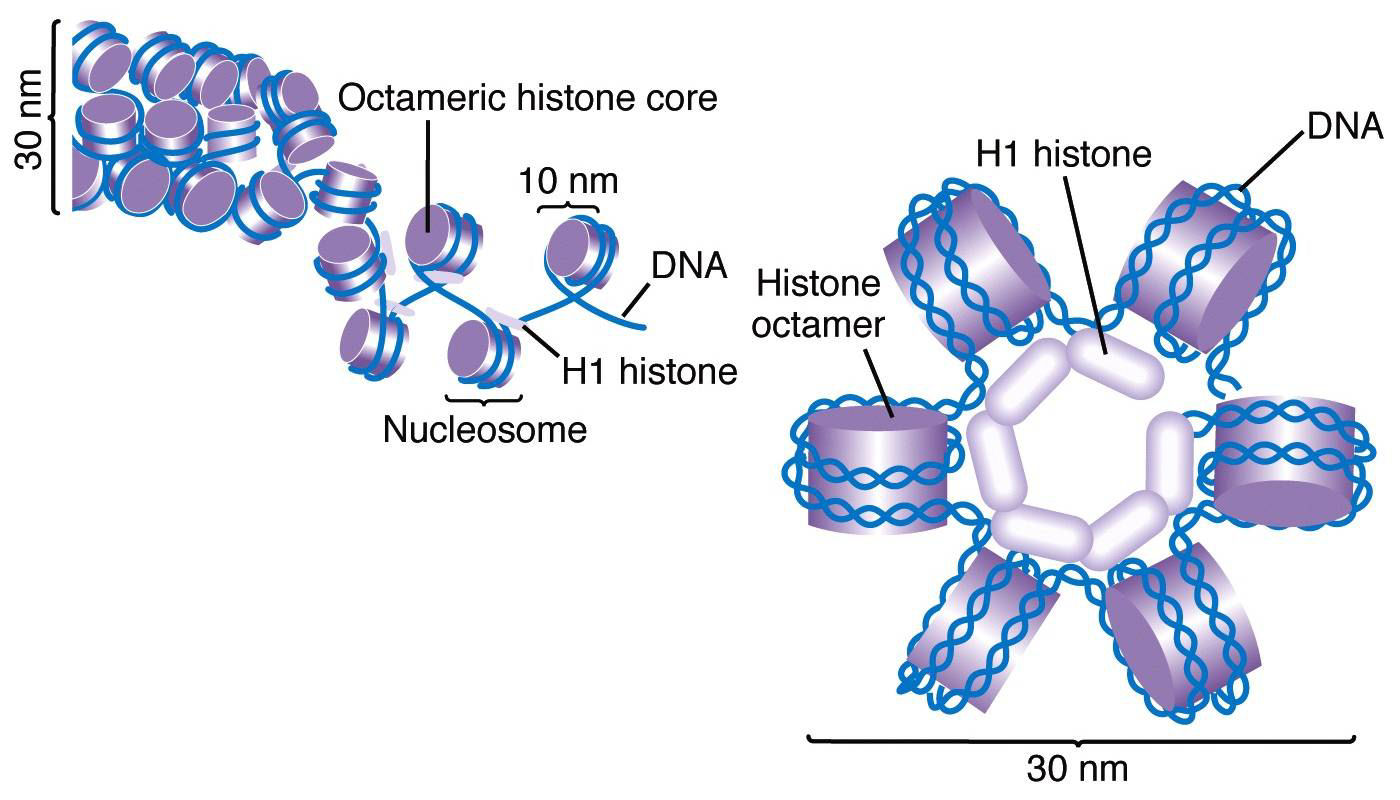
This description of transcription and the ways in which transcription factors affect it spurred us to ask this follow up question: Are there any other ways in which scientists can help manipulate a cell so that certain genes are expressed more? Dr. Salem then went on to describe how we can sometimes aid a cell in expression a gene more often through histone interactions. We asked what histones were and she told us that they are proteins that aid in the ordering and packaging of DNA molecules. They essentially act as spindles around which DNA molecules are wound into structures called nucleosomes. Dr. Salem elaborated by saying that a DNA molecule must be unwound from around its histone before transcription ban take place. This is because the two strands of DNA must be broken apart from each other so that polymerase can read the nucleotide sequence and fabricate mRNA. Because there is not enough room in between the two strands of DNA for polymerase to fit, the DNA must be uncoiled. Some scientists are taking advantage of this knowledge by forcing DNA to remain uncoiled for longer periods of time. This allows the cell to make more copies of mRNA from the gene which may in turn be used to make more proteins. A diagram of histones can be found below.

To wrap the interview up, we asked Dr. Salem if there was anything else that we had missed that we should know. She noted that we should distinguish between two types of genes. There are genes within a cell that code for proteins that are so necessary for normal function that they are, in a sense, always turned on. Other genes, however, code for proteins that may have a much more dramatic affect within a cell. Dr. Salem surmised that gene regulation therapy, if applied to medical science, will most likely focus on these genes rather than the basal “always on” type genes. Furthermore, as a piece of advice for our group as we continue to study the nature of gene regulation, Dr. Salem warned us that the field of genetics is a very vast one. Many scientists devote their entire lives to studying very specific aspects of genetics and gene regulation. She therefore suggested that we narrow the scope of any future research that we may conduct for fear of being overwhelmed. We then thanked Dr. Salem for her time and told her how much we enjoyed talking with her. She wished us the best of luck on our blog and said she would look into grid-computing a little more. The interview lasted approximately thirty-five minutes as Dr. Salem had a department meeting she needed to attend.

As a result of this interview, we learned much about the regulation of genes due to the manipulation of histones and transcription factors. This was especially pertinent information to dna@home as it is devoting processing power to search for the nucleotide sequences that transcription factors bind to in the genomes of Yersinia pestis and Mycobacterium tuberculosis. As a group, we now possess a better understanding of both the importance of finding these elusive nucleotide sequences and what can be done with them once they are found.

Thursday, January 24, 2013

Intro

        Grid computing in a nutshell is a network of computers working together to run statistical data for a certain project. A single computer is limited to the amount of work that it can do based on the processor and storage. However, when the work is distributed to millions of different computers to run different data, it maximizes the output of data. It is also important that the grid system is safe for all of the computers involved, that the computers maintain productivity with the system being run, and the system is run seemingly unknown to the user. It is a complex process, but a very effective process when enough people and resources are involved.
       The project we have decided to run is called DNA@Home, which is used to discover what regulates genes in DNA. At any moment, certain genes are turned "on" and others are turned "off", and this program will allow us to make more sense of how this regulation occurs by using statistical algorithms. More specifically this project is gearing its work towards diseases such as Mycobacterium tuberculosis and Yesinia pestis by examining their genome.  


Reference: